
Building a fuller picture of cancer inequities
Our central question is simple to ask and difficult to answer: why do advances in cancer research and care fail to benefit all communities equally? SAMBAI studies that question across breast, prostate, and pancreatic cancers in populations of African descent. We bring social context, environmental exposures, genetic ancestry, tumor biology, and patient experience into the same research frame. [1]
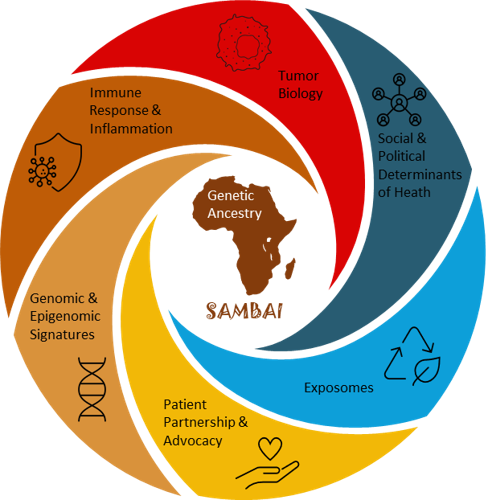
The SAMBAI lens captures the multifaceted set of factors that lead to inequitable outcomes in cancer.
Building SAMBAI to focus on the African diaspora is also a proof of principle that the framework is effective and can be utilized in similar complex inequalities across other populations.
The research behind the past and current quarter of Year 2.
Much of the work in a global study happens before a result can be announced. During this quarter, our effort has centered on aligning data and research practices across participating sites. A tumor sequence, an exposure measure, and a neighborhood indicator become more useful when we can establish how each was collected, whose experience it represents, and whether measurements can be compared responsibly across settings. Those are scientific questions as well as operational ones.
Our analysis teams are building toward linked studies of inherited variation, tumor features, immune biology, and the conditions that shape diagnosis and treatment. This approach is deliberately broader than a comparison by racial category alone. Genetic ancestry can help answer questions about inherited variation; social conditions and health care delivery need their own measurements. Neither can stand in for the other. [1,2]
A concrete example: what a reference genome can miss
A SAMBAI-associated preprint led by Rachel Martini, in collaboration with Nyasha Chambwe (both Cancer Grand Challenge Future Leaders) revisited African pan-genome contigs representing 296.5 million bases of sequence absent from the older GRCh38 reference. The team compared these sequences with newer telomere-to-telomere and human pangenome assemblies. Many contigs could be placed in newer references, while 742 remained unmapped under the study criteria. Some of the unresolved sequence showed predicted functional features. The work is a preprint, so its findings should be interpreted with that status in mind. [3]
The practical lesson is about measurement. If a reference genome does not represent a sequence well, an analysis may miss or misinterpret variation. Better references can improve discovery, but they do not by themselves establish a patient-level cancer risk factor or a treatment decision. That translation requires additional validation.
People and partnerships shape the evidence
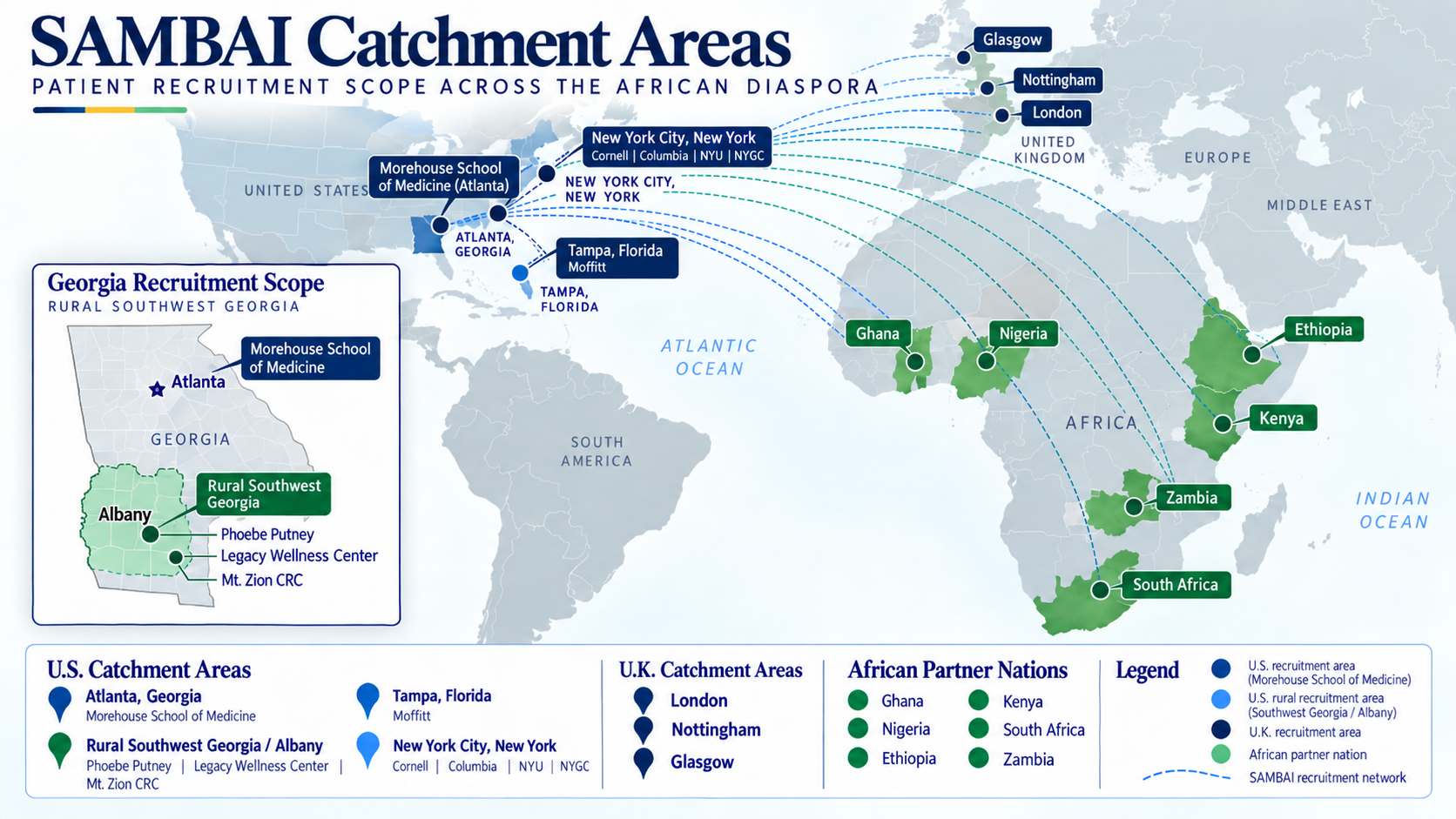
SAMBAI spans research partnerships in Africa, the United Kingdom, and the United States, with patient advocates contributing to the questions we ask and how we communicate results. [1] Local approvals, data governance, sample handling, and consistent clinical annotation are essential to a dataset that partners can trust and use. We are continuing that work alongside the analyses. We also want the people and institutions who make this research possible to see a clear account of what was learned and what remains uncertain.
What comes next
The coming work is to complete comparable analyses across cohorts, connect molecular findings with well-measured exposures and care pathways, and share results as each analysis clears scientific and partner review. We will report specific findings with their denominators, methods, limitations, and publication status. Our measure of progress is whether the evidence helps explain inequity more precisely and ultimately points toward changes in prevention and care.
About SAMBAI. The Societal, Ancestry, Molecular and Biological Analyses of Inequalities team is a Cancer Grand Challenges collaboration led from Morehouse School of Medicine. [1]
Sources
[1] Cancer Grand Challenges. SAMBAI. https://www.cancergrandchallenges.org/sambai
[2] Cancer Grand Challenges. Cancer inequities challenge. https://www.cancergrandchallenges.org/challenges/active-challenges/cancer-inequities
[3] Martini R, et al. African Pan Genome Contigs Expose Biologically Relevant Sequence Still Hidden from Human Reference Frameworks. bioRxiv preprint, 2026; doi:10.1101/2025.08.15.670543. https://pubmed.ncbi.nlm.nih.gov/41993395/
